
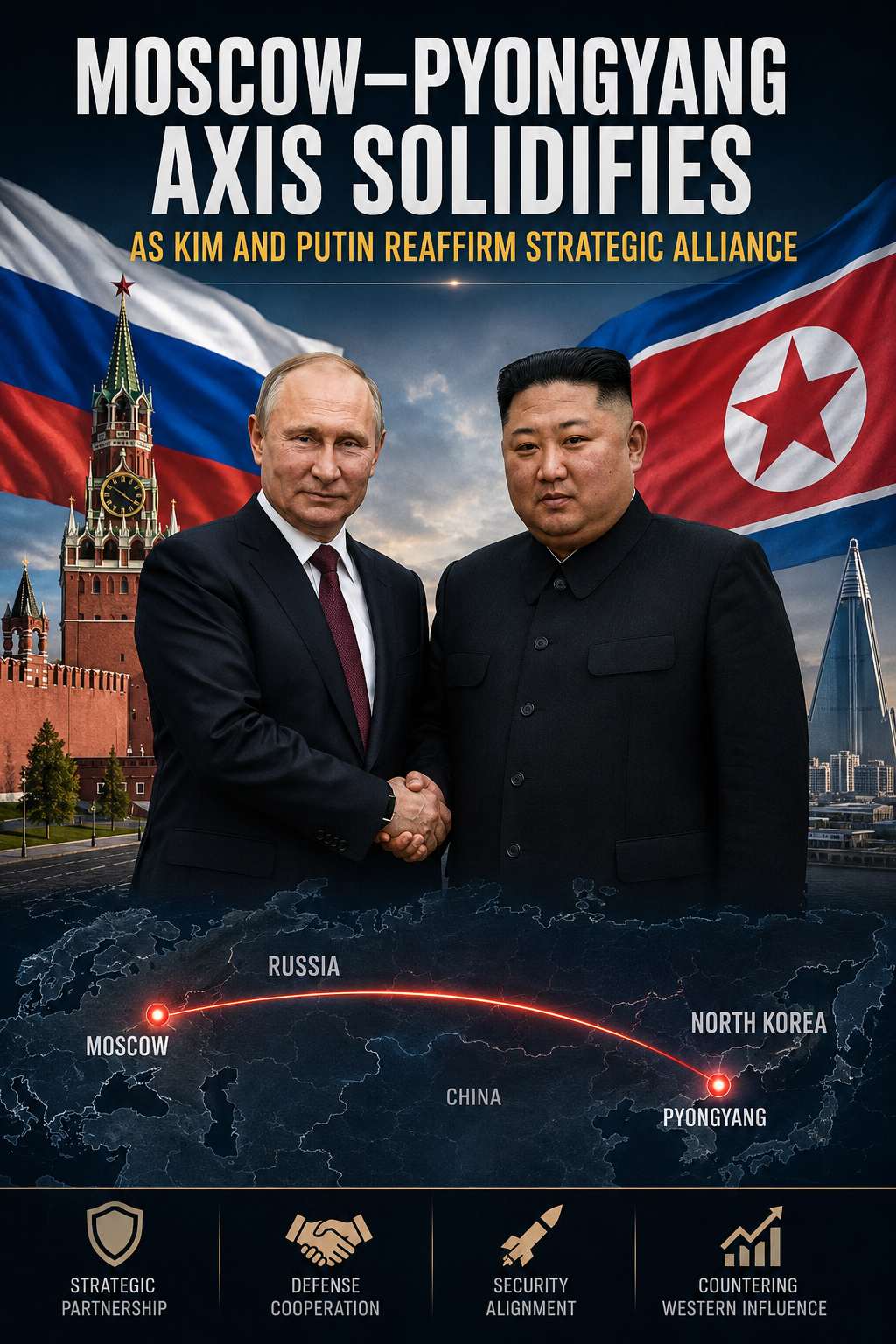
Moscow–Pyongyang : Seoul/Moscow — North Korean leader Kim Jong Un and Russian President Vladimir Putin exchanged high-level official messages on the occasion of ‘Korea Liberation Day,’ reiterating their resolve to further strengthen bilateral ties in defense and other sectors. This exchange reflects the rapid consolidation of an anti-Western strategic bloc spanning Eurasia and Northeast Asia.
Moscow–Pyongyang A Blend of Historical Symbolism and Modern Geopolitics
‘Liberation Day’ marks the end of Japanese colonial rule on the Korean Peninsula in 1945. In his telegram to Pyongyang, President Putin emphasized the wartime alliance between Soviet Red Army soldiers and Korean fighters. He stated that the “traditions of wartime brotherhood” forged during World War II remain the foundation of modern bilateral relations today.
Saudi Gazette
Putin emphasized that relations between Moscow and Pyongyang have reached an “unprecedented level of comprehensive strategic partnership.” He noted that both nations are working together across all sectors to address regional security challenges and build a “multipolar world order.”
Anadolu Agency
In his response, Kim Jong-un pledged to further strengthen their “invincible friendship.” He stated that North Korea would steadfastly honor mutual defense agreements and shared diplomatic priorities. Signaling further cooperation, the Russian training ship ‘Pallada’ arrived at the North Korean port of Wonsan for a goodwill visit to mark the anniversary.
KELO-AM
Implementation of the Comprehensive Strategic Partnership
This message reflects the active momentum of the ‘Comprehensive Strategic Partnership Treaty.’ The agreement includes a mutual defense provision, obligating either nation to provide immediate military assistance should the other come under attack.
- Military and Logistical Synergy: This alliance has moved beyond diplomatic coordination to achieve deep operational integration. It encompasses the transfer of conventional weaponry, technical defense advice, and extensive technical cooperation
- Circumventing Sanctions and Economic Corridors: Both capitals are establishing parallel financial settlement channels, energy trade agreements, and bilateral transit mechanisms to bypass sanctions imposed by Western nations. Diplomatic Protection: Moscow has consistently utilized its veto power and diplomatic platforms to shield Pyongyang’s ballistic missile program from punitive UN actions.
Moscow–Pyongyang Divergent Perspectives on the Korean Peninsula
Alongside the strengthening ties between Moscow and Pyongyang, deep rifts are evident in Northeast Asian diplomacy. While Seoul has recently reiterated its call to transform the 1953 Korean Armistice into a permanent “peace regime,” Pyongyang has rejected overtures for dialogue, citing the ongoing joint military exercises between South Korea and the United States.
As Washington, Tokyo, and Seoul strengthen their trilateral defense framework, the deepening partnership between Moscow and Pyongyang confirms that Northeast Asia has become entrenched in a completely divided security architecture. To understand the key aspects of these geopolitical developments: