
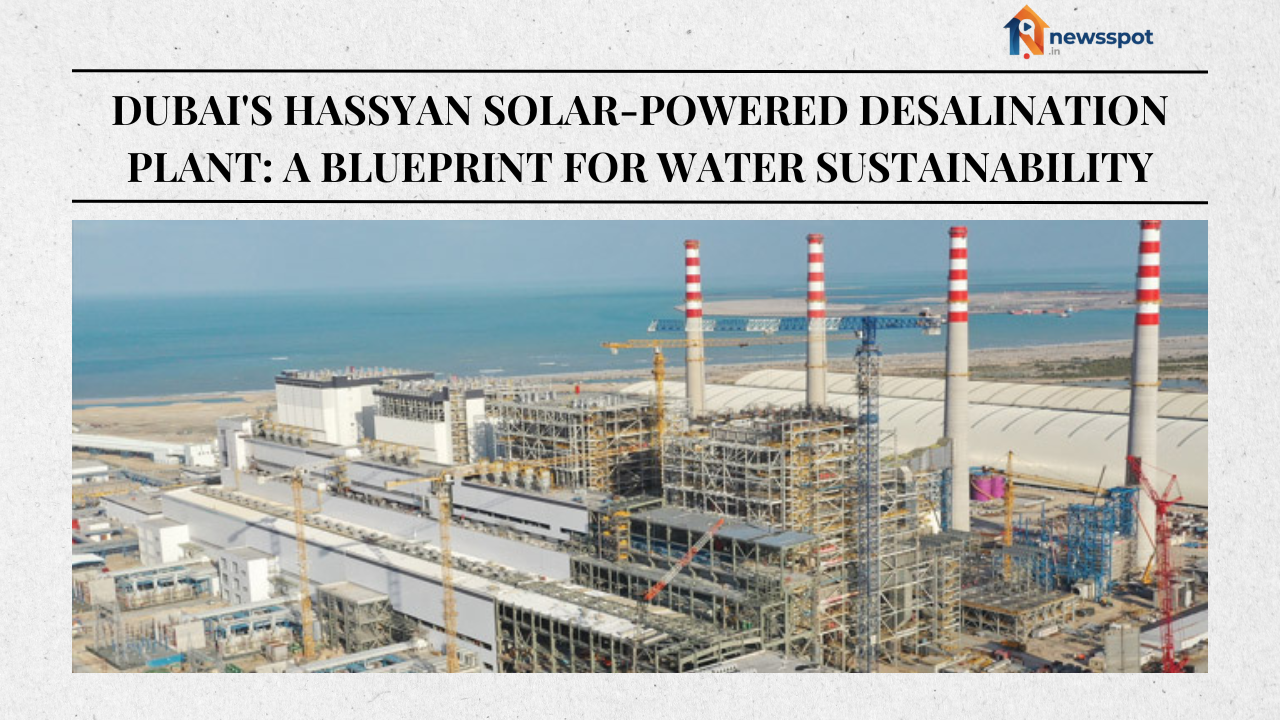
Solar-Powered Desalination Plant :- Nestled approximately 55 kilometers southwest of Dubai Creek in the United Arab Emirates (UAE), the Hassyan Independent Water Plant (IWP) represents a groundbreaking leap in sustainable water production. Set to become the world’s largest reverse osmosis (RO) desalination facility powered entirely by solar energy, the project aligns with Dubai’s ambitious Dubai Clean Energy Strategy 2050 and Net Zero Carbon Emissions Strategy 2050. Developed by the Dubai Electricity and Water Authority (DEWA) in partnership with ACWA Power and serviced by Veolia Water Technologies, Hassyan aims to deliver 100% clean-energy desalinated water, reducing reliance on fossil fuels and combating water scarcity in arid regions.
Key Specifications and Capacity Solar-Powered Desalination Plant
- Production Capacity: 818,000 cubic meters per day (m³/day), equivalent to approximately 180 million imperial gallons per day (MIGD). This output will supply safe, reliable drinking water to over two million residents—about 20% of Dubai’s population.
- Beneficiaries: Primarily serving Dubai’s growing urban needs, with potential for regional expansion.
- Total Investment: €848 million (approximately AED 3.37 billion or USD 920 million), including a €295 million contract for Veolia’s pre- and post-treatment technologies.
Advanced Technology and Operations
Hassyan employs cutting-edge seawater reverse osmosis (SWRO) technology, optimized for energy efficiency:
- Core Process: A two-pass SWRO membrane system that filters seawater at 43–45% temperature and salinity levels to minimize energy use. Pretreatment involves dissolved air flotation (DAF) using SIDEM’s Spidflow® technology, followed by dual media filters to remove particulates and organics.
- Energy Efficiency: Achieves a remarkably low consumption of 2.9 kWh/m³—up to 3x cheaper than traditional methods—thanks to solar integration and advanced automation.
- Solar Power Integration: Fully powered by photovoltaic (PV) solar arrays, eliminating fossil fuel dependency. The plant leverages excess solar energy recovery systems for continuous operation, supporting Dubai’s goal of 100% renewable desalination by 2030. This hybrid setup includes energy storage to ensure 24/7 reliability.
- Brine Management: Controlled discharge of brine with monitored temperature, salinity, and chemical parameters to protect marine ecosystems, adhering to stringent UAE environmental standards.
Timeline and Progress
- Construction Start: 2023, under the Independent Water Producer (IWP) model.
- Current Status (as of November 2025): 78% complete, with initial operations at 50% capacity (454,600 m³/day) already underway.
- Full Operations: Expected to open in 2026 and reach maximum capacity by 2027.
Environmental and Global Impact
Traditional desalination relies on energy-intensive multi-stage flash (MSF) or multi-effect distillation (MED) powered by natural gas, contributing to high carbon emissions (up to 4–5 kg CO₂ per m³ of water). Hassyan’s solar-driven RO approach slashes this footprint to near-zero, saving an estimated 1.2 million tons of CO₂ annually while producing millions of gallons of pure water daily without atmospheric pollution.
This carbon-neutral model positions the UAE as a leader in arid-zone innovation, offering a scalable template for water-stressed nations like Saudi Arabia, Australia, and parts of Africa. By 2030, it will integrate with Dubai’s Mohammed bin Rashid Al Maktoum Solar Park (target: 5,000 MW), amplifying regional renewable capacity. Beyond water security, Hassyan fosters economic diversification, job creation (thousands in construction and operations), and technological exports in green desalination.
In essence, Hassyan isn’t just quenching Dubai’s thirst—it’s irrigating a sustainable future, proving that sun-scorched deserts can pioneer global water independence through ingenuity and clean tech