
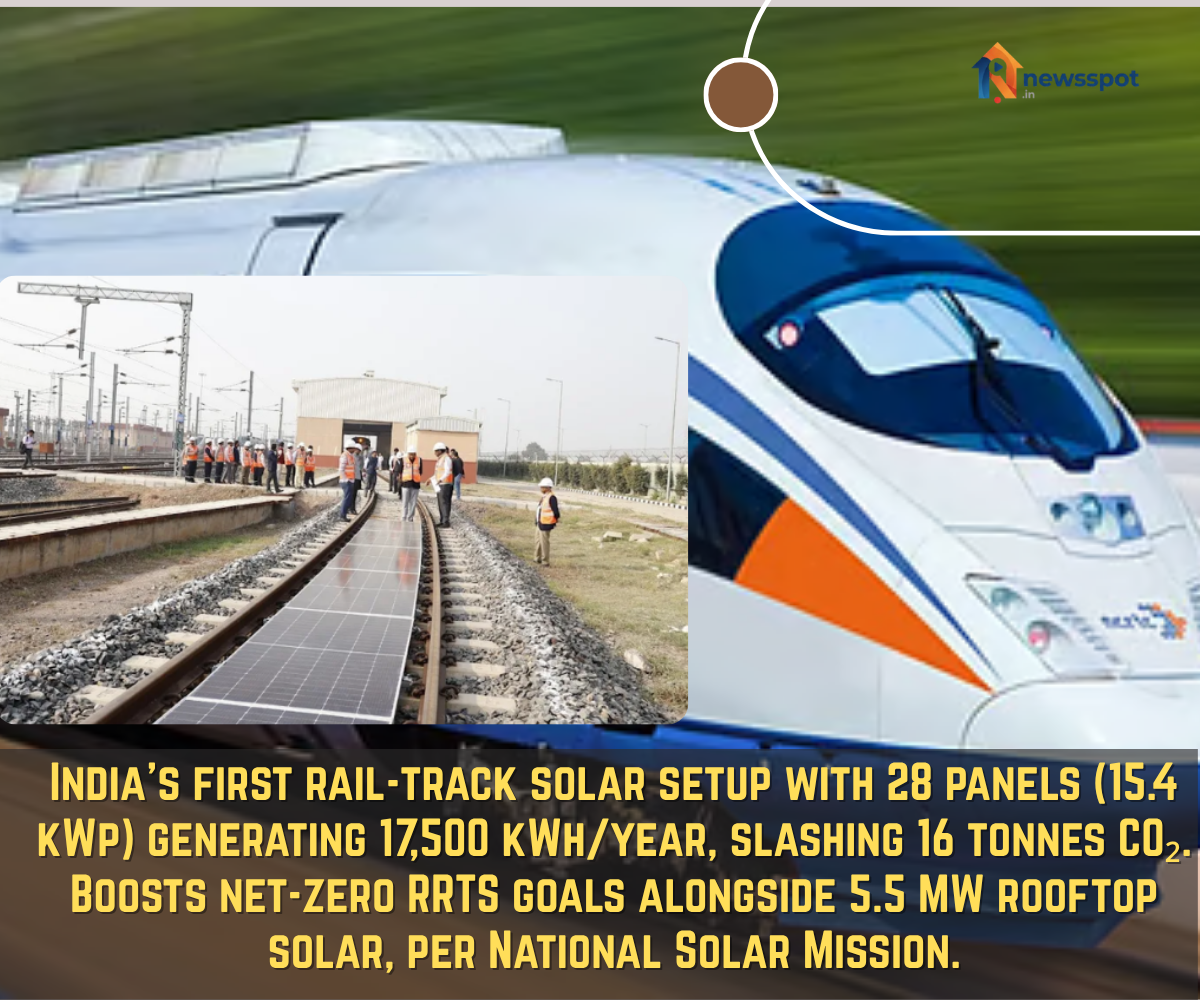
NCRTC’s ‘Solar on Track’ Project: The National Capital Region Transport Corporation (NCRTC) has launched the innovative ‘Solar on Track’ project, marking the first installation of solar panels directly on railway tracks in any Rapid Rail Transit System (RRTS) or metro network in India. This pilot initiative at the Namo Bharat Depot in Duhai, Ghaziabad, transforms unused track space into a renewable energy source, advancing NCRTC’s commitment to eco-friendly mobility along the Delhi-Meerut RRTS corridor. Duhai becomes the second city in India to feature such track-mounted solar panels, following Banaras Locomotive Works (BLW) in Varanasi.
NCRTC’s ‘Solar on Track’ Project: Project Background
Initiated as part of NCRTC’s broader solar policy, ‘Solar on Track’ leverages idle infrastructure to generate clean energy without disrupting rail operations. The project employs an indigenously designed installation procedure that allows panels to be fitted between the rails, ensuring seamless coexistence with train movements. Launched in November 2025, it exemplifies a shift toward integrating clean energy assets into urban transit systems, setting a precedent for scalable green innovations nationwide.
Technical Specifications
- Location: Pit Wheel Track at the Namo Bharat Depot, Duhai, Ghaziabad, spanning a 70-meter stretch.
- Components: 28 high-efficiency polycrystalline solar panels, each with a capacity of 550 Watt-peak (Wp).
- Total Capacity: 15.4 kWp micro solar power plant.
- Installation: Panels are mounted directly on the tracks using a non-intrusive method, converting depot space into a functional energy generator.
Energy Generation and Environmental Impact
The system is projected to produce approximately 17,500 kWh of electricity per year, sufficient to power operations and reduce reliance on grid energy. Environmentally, it offsets around 16 tonnes of CO₂ emissions annually, equivalent to the carbon sequestration of planting over 800 trees. By harnessing solar energy in a space-efficient manner, the project minimizes land use while maximizing output, promoting a circular economy in rail infrastructure.
Broader Sustainability Initiatives
- Rooftop Solar: 5.5 MW already commissioned, with plans for 15 MW peak across stations, depots, and buildings.
- Regenerative Braking: Namo Bharat trains recover kinetic energy during braking, converting it to electrical power for reuse.
- Water Management: Rainwater harvesting and sewage treatment plants for zero-liquid discharge.These efforts collectively aim for net-zero carbon emissions across NCRTC facilities.
Alignment with National Goals
The project aligns with India’s National Solar Mission, emphasizing clean energy adoption in transport. NCRTC targets 70% of its energy needs from renewables, fostering energy-efficient operations and supporting the government’s push for sustainable urban development. It underscores a holistic approach to embedding regenerative technologies in mobility infrastructure.
Future Outlook
While this is a pilot, NCRTC envisions expanding track-based solar installations to contribute to the 15 MW rooftop target and beyond. Success could inspire replication across other RRTS, metro, and railway networks, potentially revolutionizing India’s rail sector into a self-sustaining green ecosystem. Ongoing monitoring will assess scalability, with potential for nationwide adoption under the National Solar Mission framework.