
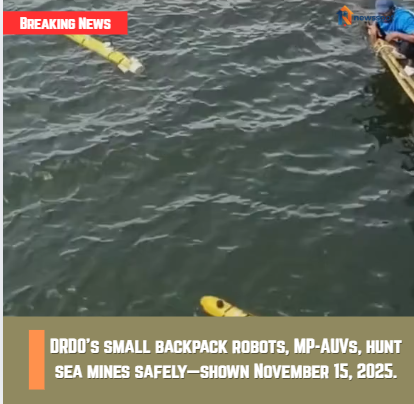
DRDO’s Easy-to-Carry Underwater Robots : India’s Defence Research and Development Organisation (DRDO) has achieved a milestone with its Man-portable Autonomous Underwater Vehicles (MP-AUVs), unveiled on November 15, 2025, for mine countermeasure (MCM) missions. Developed by the Naval Science and Technological Laboratory (NSTL) in Visakhapatnam, alongside partners like NPOL and RCI, this system deploys lightweight, AI-driven drones to detect and neutralize underwater mines—enhancing naval safety without risking human lives.
Development and Design: Portable Power
The project addresses gaps in traditional MCM, which rely on risky manned operations or expensive imports. NSTL’s collaboration with industry giants like BEL ensures indigenous production, cutting costs and boosting scalability.
Each AUV is backpack-portable (under 20 kg), deployable from shores or small boats to 100m depths. The multi-vehicle swarm—up to 6 units—covers large areas via acoustic networks, sharing data for coordinated hunts.
In an era of rising maritime threats in the Indian Ocean, where mines pose asymmetric dangers from adversaries like China and Pakistan, the MP-AUVs promote self-reliance under Atmanirbhar Bharat. Trials in the Bay of Bengal confirmed their prowess, positioning India as a contender against global systems like the U.S. Knifefish.
Tech Highlights: Sensors, AI, and Swarm Smarts
- Sensors: High-res Side Scan Sonar maps seabeds, spotting 10cm objects up to 200m away; HD cameras with LEDs inspect targets visually.
- AI Autonomy: Deep-learning classifies mine-like objects (MLOs) with 90%+ accuracy, reducing false alarms by 70%. Algorithms handle obstacle avoidance and GPS-free navigation using IMUs and DVLs.
- Performance: 4+ hours endurance at 4 knots, with modular slots for upgrades like explosive tools.
Operators use a intuitive control station for planning and monitoring, minimizing intervention.
Bay of Bengal Trials: Mission Accomplished
Conducted in late October 2025 at NSTL facilities, trials simulated cluttered harbors. Deploying 4-6 AUVs, teams achieved:
- 95% detection rate.
- 40% faster searches via swarms.
- 92% AI-human match in classifications.
No major issues; minor acoustic tweaks pending. DRDO’s Dr. Samir V. Kamat called it a “deployable, intelligent solution” for rapid, low-risk ops.
X erupted with praise—clips of swarming AUVs went viral, dubbed “underwater warriors.”
Strategic Impact and Future
These AUVs fortify India’s chokepoints, integrating with P-8I aircraft and destroyers for layered defense. At a fraction of foreign costs, they deter threats while saving lives.
Production starts soon, with 50-100 units by mid-2026. Upgrades may add deeper sonar or ASW roles. Challenges like diverse terrains persist, but DRDO’s legacy—from Varunastra to SMART—inspires confidence.