
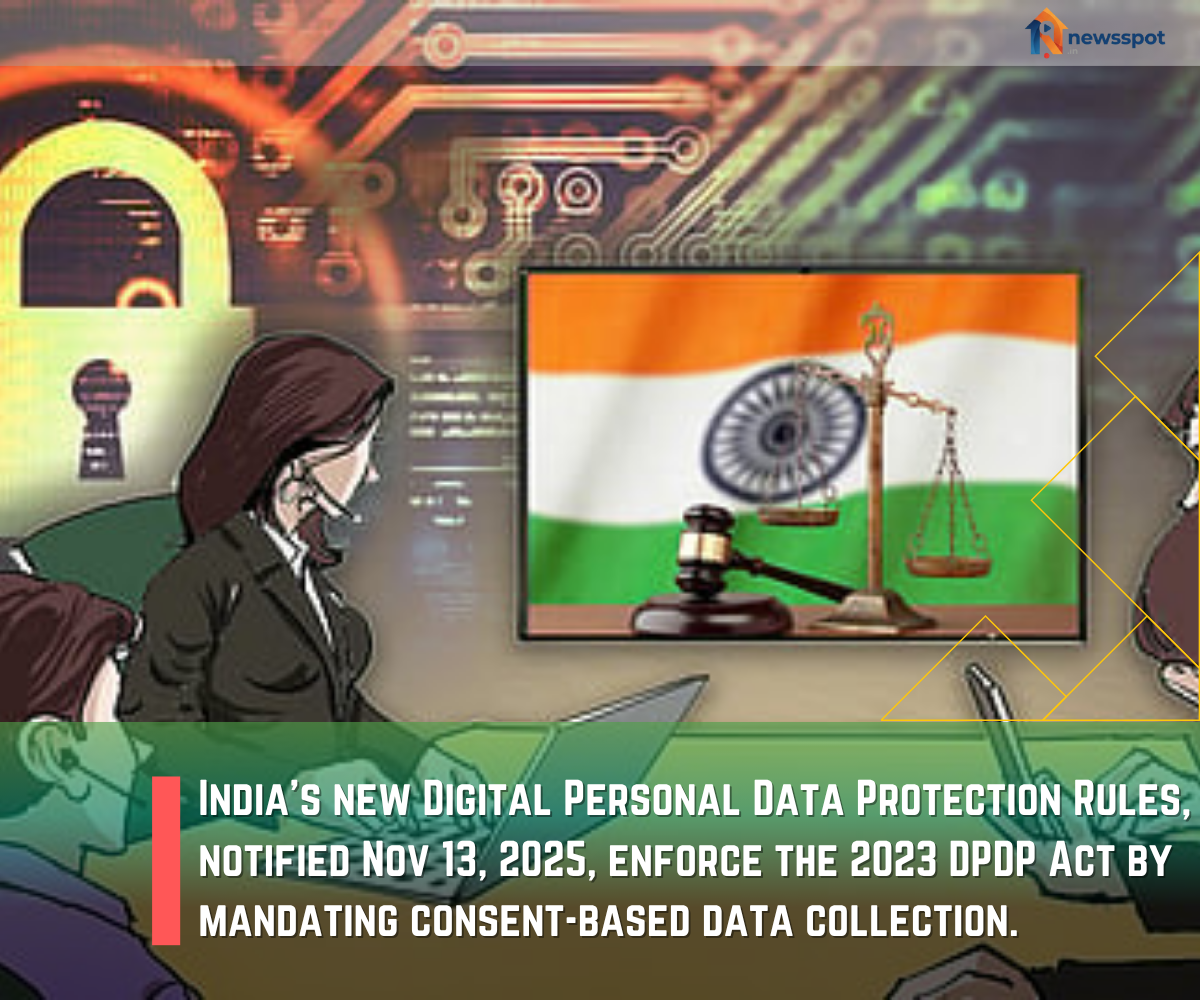
The Digital Personal Data Protection Rules, 2025 (DPDP Rules) were notified by India’s Ministry of Electronics and Information Technology (MeitY) on November 13-14, 2025, operationalizing the Digital Personal Data Protection Act, 2023 (DPDP Act). This framework, rooted in the Supreme Court’s 2017 recognition of privacy as a fundamental right, aims to safeguard personal data in digital ecosystems while balancing innovation and user rights. It applies to “data fiduciaries” (entities determining data processing purposes) and “data processors” (those handling data on behalf of fiduciaries), covering both domestic and foreign entities targeting Indian users. Exemptions exist for government-issued IDs, legal enforcement, court orders, offense prevention, and certain research or startup activities.
Key Provisions
- Consent Management: Data processing requires free, specific, informed, unconditional, and unambiguous consent, obtained via clear, plain-language notices before collection. Consent can be withdrawn anytime, triggering data erasure within specified timelines. Registered “consent managers” (independent entities) will oversee consent-based sharing, with a one-year registration deadline. Notices must detail data usage, rights, and grievance contacts.
- Data Minimization and Retention: Personal data must be collected, used, and retained only for specified, legitimate purposes, with minimization as a core principle to avoid excess collection. Data fiduciaries must erase data after its purpose is fulfilled or upon withdrawal, unless legally required (e.g., for compliance). Users receive 48-hour notices before erasure, except if continuing platform use. Retention beyond one year is prohibited without justification.
- Breach Notification: In case of a personal data breach, fiduciaries must notify affected individuals “without delay” (typically within 72 hours) via user accounts or registered modes, detailing the breach’s nature, timing, impacts, and remedial steps. The Data Protection Board of India (DPB) must also be informed immediately, including breach extent and mitigation measures.
- Child and Vulnerable Data Protection: Verifiable parental/guardian consent is mandatory for processing data of children under 18 or persons with disabilities. This involves the child nominating a parent, followed by identity verification using reliable details, government IDs, or Digital Locker tokens. Exceptions apply for healthcare, education, or child safety services limited to protective purposes. No tracking, ads, or behavioral monitoring for children without consent.
- Obligations for Data Fiduciaries and Processors: Fiduciaries must implement “reasonable security safeguards” like encryption, firewalls, masking, and access controls; publish data protection officer contacts; and enable grievance redressal within 15-30 days. Processors must follow fiduciary instructions and maintain records. Cross-border data transfers are allowed unless restricted by the Central Government for sovereignty/security reasons.
- Significant Data Fiduciaries (SDFs): Platforms handling large/sensitive volumes (e.g., Meta, Google, OpenAI) will be notified as SDFs based on risk assessments. They require annual Data Protection Impact Assessments (DPIAs), third-party audits, appointing India-based data officers, and appointing consent managers.
Penalties
The DPB, a digital office led by a chairperson and members (selected via a committee under the Cabinet Secretary), will investigate breaches and impose monetary penalties up to ₹250 crore per violation under the DPDP Act. Penalties are graded by breach severity, with leniency for small businesses/startups to encourage compliance without stifling growth.
Phased Implementation Timeline
- Immediate (upon notification, Nov 13-14, 2025): DPB establishment, core definitions, and basic enforcement notifications.
- 12-18 Months: Staggered rollout for key obligations like privacy notices, consent mechanisms, child data rules, security safeguards, breach reporting, data retention/erasure, and SDF audits. Consent manager registration: 1 year. Full compliance expected by mid-2027, providing a “breathing room” for adaptation.