
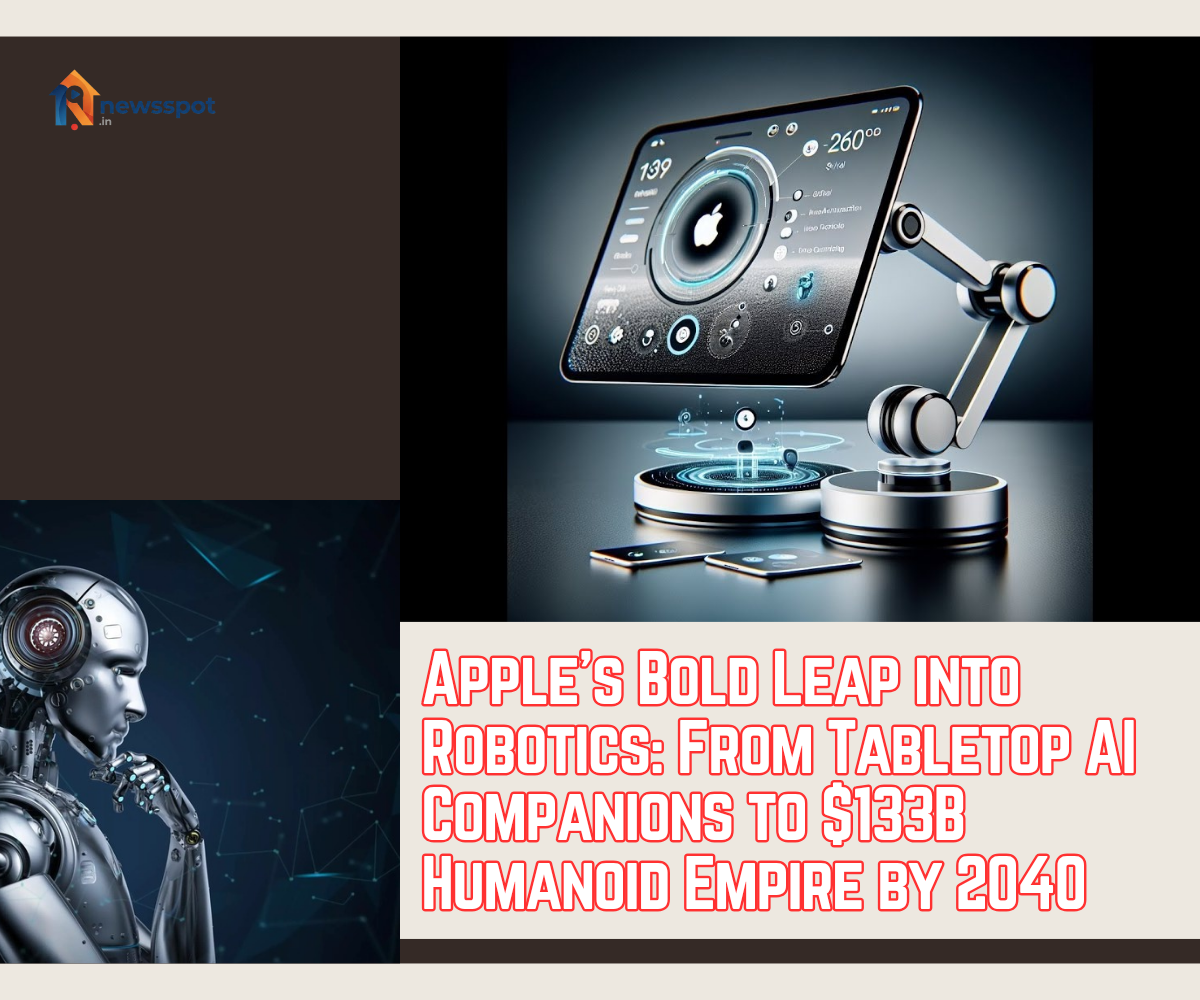
Apple’s Bold Leap into Robotics : Apple is pivoting to robotics as its next major growth engine, targeting $133B in annual revenue by 2040 via embodied AI devices. This leverages Apple Silicon, AI expertise from Apple Intelligence, and a 2.3B-device ecosystem. Starting with consumer-friendly entry points, it scales to affordable humanoids, positioning robotics as Apple’s second-largest segment after iPhone.
Apple’s Bold Leap into Robotics Key Projections
- Market Size: Global embodied AI hits $5T by 2050; Apple captures 9% U.S. humanoid share (415K units/year by 2040 at $30K ASP).
- Revenue Breakdown: Device sales + services (subscriptions, maintenance) = $133B/year; bullish case: $300B with 22% share.
- Timeline: 2026 smart hub; 2027 tabletop robot; 2030s mobile/humanoids.
Product Lineup
- 2026: Smart Home Hub – Stationary AI controller for media, calls; runs Charismatic OS.
- 2027: Tabletop Robot (J595) – iPad-faced arm (7″ display, 360° rotation); Siri-powered companion for conversations, FaceTime, smart home tasks. On-device AI for privacy.
- 2030s: Humanoids – $30K bipedal models for chores, companionship; advanced vision/mobility.
Tech & Advantages
- Core: Custom Apple Silicon for efficient AI; seamless integration (e.g., iPhone handoffs).
- Edges: Premium design, ecosystem lock-in; builds on Project Titan patents.
- Competitors: Tesla Optimus, Amazon Astro; Apple’s focus: consumer polish.
Challenges and Risks
- Technical Hurdles: Refining AI for safe, intuitive interactions—e.g., distinguishing fragile items or navigating cluttered homes. Battery life, heat management in compact forms, and actuator durability remain prototypes pain points.
- Economic Barriers: High initial costs ($30K+ for humanoids) may limit adoption until economies of scale kick in; recurring services must prove value to offset hardware prices.
- Regulatory and Ethical: Privacy concerns with always-on cameras/microphones; safety standards for home robots amid rising AI scrutiny.
- Market Adoption: Convincing consumers to embrace “robotic companions” requires cultural shifts, especially in privacy-sensitive markets like the U.S. and EU.
- Delays: Apple’s hardware timelines often slip (e.g., LLM-enhanced Siri postponed to 2026), potentially pushing robotics milestones.
Competitive Landscape
- Tesla Optimus: Elon Musk’s humanoid for factory/home use; aims for mass production by 2026, with 80% of Tesla’s future value tied to it.
- Amazon: Over 1 million wheeled robots in warehouses; expanding to consumer via Astro.
- Foxconn: Deploying humanoids in Nvidia’s Texas AI plants.
- Others: Figure AI, Boston Dynamics—focus on industrial, but eyeing consumer.
Conclusion and Implications
Apple’s robotics pivot represents a bold bet on embodied AI as the next computing paradigm, transforming passive devices into proactive partners. By 2040, success could redefine Apple as an AI-robotics leader, boosting market cap and diversifying beyond smartphones. Investors should monitor 2026 hub launches and 2027 prototypes for validation. For now, this remains speculative—rooted in leaks from Bloomberg’s Mark Gurman and Morgan Stanley’s modeling—but aligns with Apple’s history of disrupting categories through integrated innovation. Further details may emerge at WWDC 2026 or dedicated AI events.