
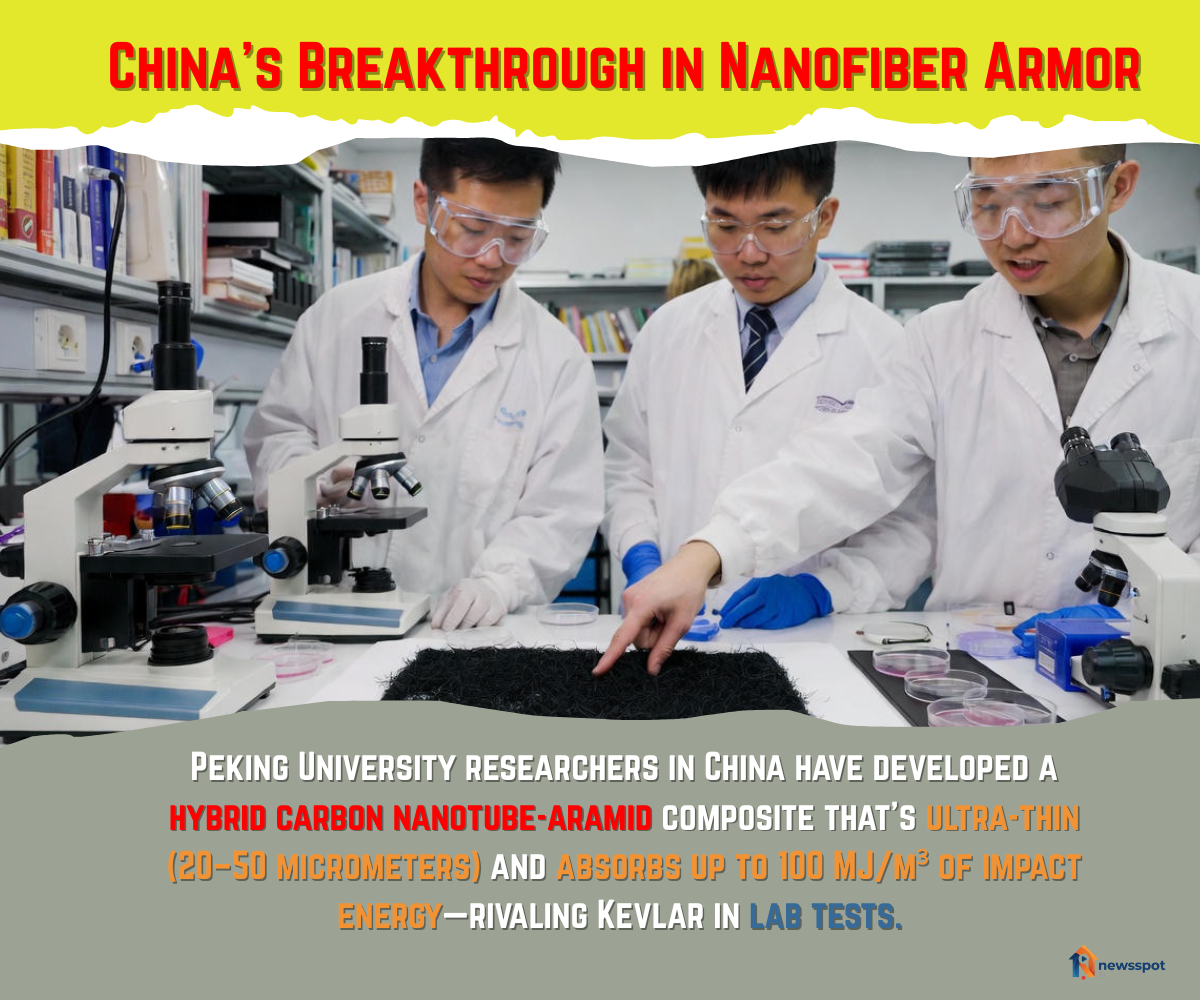
Nanofiber Armor : In a landmark advancement in materials science, researchers at Peking University, led by Professor Jin Zhang, have developed a hybrid composite material combining single-walled carbon nanotubes (SWCNTs) with heterocyclic aramid polymers. Published in the journal Matter (DOI: 10.1016/j.matt.2025.102496) in late 2024, this innovation addresses key limitations in traditional ballistic fabrics like Kevlar, such as fiber slippage under high-impact stress. The resulting fabric—dubbed a “carbon nanotube/heterocyclic aramid composite”—offers superior tensile strength and energy absorption while remaining ultra-thin and lightweight. This could revolutionize personal protective equipment (PPE), military armor, and aerospace applications by enabling thinner, more mobile defenses without compromising protection.
The study builds on decades of research into carbon nanotubes (CNTs), which are renowned for their exceptional strength (up to 100 times stronger than steel at the molecular level) but have historically underperformed in macro-scale applications due to alignment and bonding challenges. By integrating CNTs with aramid (the base polymer in Kevlar), the team created a tightly interlocked lattice that maintains structural integrity during dynamic impacts.
Nanofiber Armor Key Methods
The fabrication process involves a scalable, industrially compatible technique:
- CNT Preparation and Alignment: Long SWCNTs (lengths exceeding 1 mm) are synthesized via chemical vapor deposition and chemically treated to enhance reactivity. These are then oriented and aligned using a wet-spinning method, ensuring parallel bundling to maximize load distribution.
- Aramid Integration: Heterocyclic aramid nanofibers—derived from high-strength polymers like poly(p-phenylene terephthalamide)—are interwoven with the CNTs through a sequential assembly process. This includes surface functionalization of CNTs to promote covalent bonding, preventing slippage between fibers.
- Composite Formation: The hybrid fibers are woven into a multi-layered fabric using standard textile techniques. The process avoids high-energy inputs, making it feasible for large-scale production.
- Characterization: Materials were analyzed using scanning electron microscopy (SEM) for microstructure, tensile testing for static strength, and high-speed gas-gun impacts for dynamic performance.
This method leverages existing aramid manufacturing infrastructure, reducing barriers to commercialization.
Main Results
Lab tests demonstrated the composite’s exceptional properties, outperforming Kevlar in both static and dynamic scenarios. Key metrics include:
| Property | CNT-Aramid Composite | Kevlar (Benchmark) | Improvement |
|---|---|---|---|
| Thickness (per layer) | 0.6 mm | ~1.3 mm (single layer equivalent) | 50% thinner |
| Total Thickness (to stop bullet) | 1.8 mm (3 layers) | ≥4 mm | 55% thinner |
| Tensile Strength | ~3x Kevlar (specific value: up to 7 GPa in related CNT-aramid studies by the group) | ~2.4–3.6 GPa | 3x stronger |
| Energy Absorption | 70–100 MJ/m³ (under high-speed impact) | ~30–50 MJ/m³ | 2–3x higher |
| Impact Resistance | Reduces bullet velocity from 300 m/s to 220 m/s (1 layer); stops bullet entirely (3 layers) | Requires 4+ layers for full stop | Superior |
- Static Tests: The composite exhibited a Young’s modulus of ~150 GPa and elongation at break >4%, indicating high toughness.
- Dynamic Tests: Using a gas-gun with steel projectiles at ~900 m/s (simulating ballistic conditions), the material absorbed impacts without catastrophic failure. SEM images showed minimal delamination, with CNTs acting as “energy bridges” to dissipate shock waves.
- Highlights from Figures: Figure 3 in the paper illustrates velocity reduction curves; Figure 5 compares fracture surfaces, revealing enhanced interfacial bonding. Energy dissipation was quantified via finite element modeling, confirming the anti-slippage mechanism.
These results were validated against commercial Kevlar fabrics, with the CNT-aramid showing no fiber pull-out under strain rates up to 10³ s⁻¹.
Implications and Potential Applications
- Personal Protection: Enables bulletproof vests weighing 30–50% less than current models, improving wearability for law enforcement and civilians. Since Kevlar’s introduction in the 1960s, it has saved over 3,000 lives (per U.S. National Institute of Justice data); this could amplify that impact.
- Military and Aerospace: Ideal for vehicle plating, aircraft shielding, and exoskeletons, where weight reduction enhances fuel efficiency and maneuverability.
- Broader Impact: The alignment technique could extend to other composites (e.g., graphene-aramid), fostering innovations in robotics and sports gear. As China advances in nanotechnology, this positions the country as a leader in defense materials R&D.
Professor Zhang emphasized: “Ultra-high dynamic strength and toughness are crucial for fibrous materials in impact-protective applications… Our fabric outperforms Kevlar entirely.”
Limitations and Future Work
- Scalability Challenges: While lab-scale production yielded meter-long fibers, industrial weaving at gigapascal strengths remains unproven. Cost of high-purity SWCNTs (~$100/g) could hinder affordability.
- Real-World Testing: Tests used simulated projectiles; full NIJ-standard ballistic trials (e.g., against 9mm or .44 Magnum rounds) are needed. Environmental durability (e.g., humidity, UV exposure) was not extensively covered.
- Next Steps: The team plans to optimize CNT chirality for conductivity (enabling “smart” armor with sensors) and collaborate on pilot manufacturing. Julie Cairney, a materials expert, noted: “This approach could potentially be used to produce other new composites… enhancing safety without sacrificing mobility.”
This breakthrough, though promising, exemplifies the “valley of death” in materials translation—lab success to field deployment may take 5–10 years. Nonetheless, it marks a pivotal step toward next-generation armor. For the full paper, access via Matter journal.