
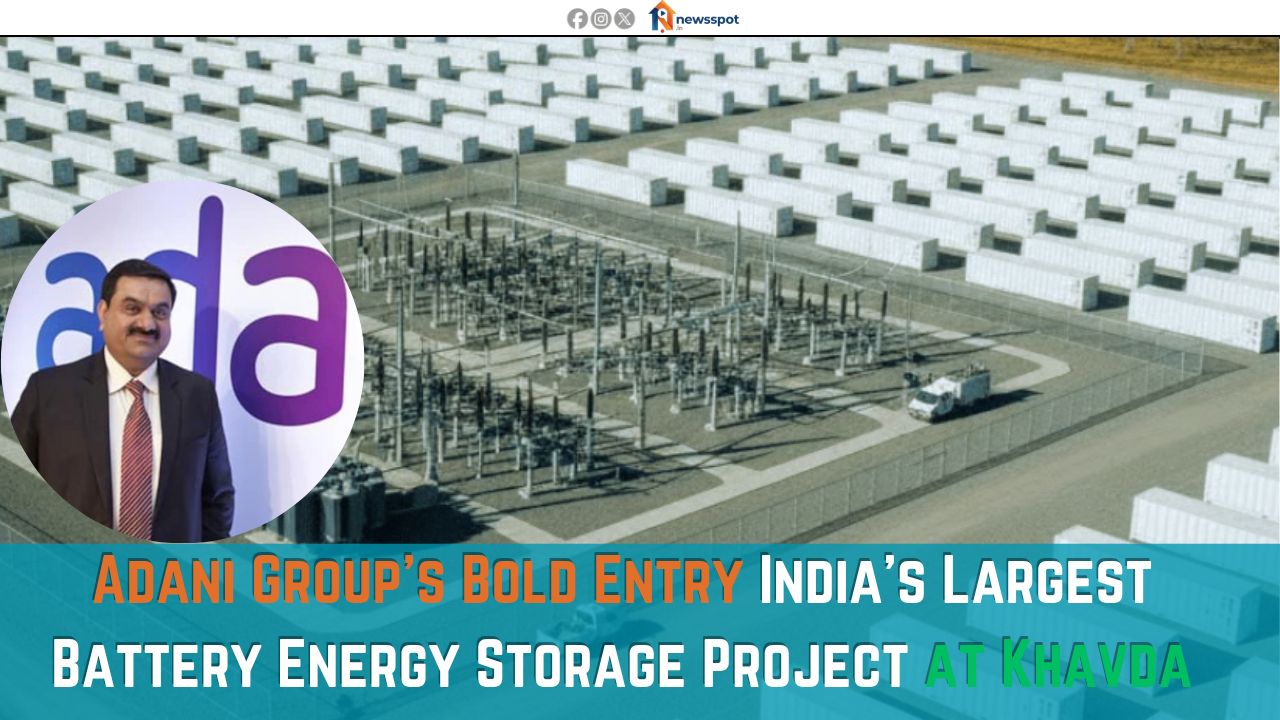
The Adani Group, a leading Indian conglomerate, has announced its strategic foray into the Battery Energy Storage Systems (BESS) sector with a landmark 1,126 MW / 3,530 MWh project at Khavda, Gujarat. This initiative marks Adani’s first major deployment in electrochemical battery storage and positions Khavda as the world’s largest combined renewable energy and storage park. Construction is underway, with commissioning targeted for March 2026. The project supports India’s ambitious clean energy targets, enhances grid stability, and aligns with global trends in renewable integration. Future expansions aim for 15 GWh by March 2027 and 50 GWh within five years.
Adani Group’s Bold Entry: India’s Largest Battery Energy Storage Project at Khavda
Key Specifications
- Power Capacity: 1,126 MW (capable of delivering power for approximately 3 hours).
- Energy Capacity: 3,530 MWh (3.5 GWh), sufficient to store and dispatch energy equivalent to powering peak demand during high-usage periods.
- Technology: Utilizes advanced lithium-ion battery technology housed in over 700 BESS containers. Integrated with smart energy management systems for optimized performance, reliability, and efficiency.
- Location: Khavda Renewable Energy Park, Gujarat—the site of Adani’s ongoing 30 GW solar PV development, with the first 1 GW phase operational since early 2024.
- Timeline: Currently in advanced construction stages; full commissioning expected by March 2026.
This single-location deployment will be India’s largest BESS installation and one of the world’s most significant, surpassing many global peers in scale and integration with renewables.
Strategic Benefits and Impact
The Khavda BESS will play a pivotal role in modernizing India’s power grid by addressing the intermittency of solar and wind energy:
Grid Stability and Peak Management: Enables energy time-shifting, storing excess renewable power during off-peak hours and dispatching it during peak demand, reducing reliance on fossil fuels.
Decarbonization and Sustainability: Supports peak load shaving, cuts carbon emissions, and facilitates 24/7 renewable power availability, contributing to India’s net-zero goals by 2070.
Economic Advantages: Ensures affordable, reliable clean energy at scale, enhancing energy security and network stability amid India’s target of 500 GW non-fossil fuel capacity by 2030.
Global Significance: As part of the Khavda park’s phased 30 GW expansion, it sets benchmarks for large-scale renewable-storage hybrids, joining leaders like Tesla’s Hornsdale project in Australia or California’s Moss Landing.
By integrating BESS with Adani’s existing solar infrastructure, the project boosts renewable penetration and positions India as a frontrunner in the global energy storage market, projected to grow rapidly due to falling battery costs.
Leadership Commentary
Gautam Adani, Chairman of the Adani Group, emphasized the transformative potential:
“Energy storage is the cornerstone of a renewable-powered future. With this historic project, we are not only setting global benchmarks but also reinforcing our commitment to India’s energy independence and sustainability. This initiative will enable us to deliver reliable, clean, and affordable energy solutions at scale.”
The Adani Group views this as a “flagship deployment” in the clean energy evolution, underscoring its pivot toward sustainable infrastructure.
Expansion Roadmap
Adani is aggressively scaling its BESS portfolio to meet surging demand:
- Short-Term: Add 15 GWh of capacity by March 2027, building on the initial 3.5 GWh.
- Long-Term: Achieve 50 GWh total within five years, complementing ongoing pumped hydro projects (e.g., a 1,250 MW facility in Uttar Pradesh).
- Broader Context: This aligns with Adani Green Energy’s 45 GW renewable target by 2030, including hybrid solar-wind-storage systems.
These plans capitalize on India’s policy incentives, such as viability gap funding for BESS and competitive bidding frameworks.
Broader Implications for India’s Energy Landscape
India’s BESS market is nascent but accelerating, with over 5 GWh tendered in 2024-2025. Adani’s entry intensifies competition among developers like Reliance and NTPC, driving innovation and cost reductions. The project advances the “Make in India” initiative by potentially localizing battery manufacturing, reducing import dependence, and fostering job creation in Gujarat’s renewable hub.
For stakeholders, this signals robust investor confidence in India’s green transition, with potential ripple effects on global supply chains for lithium-ion components.